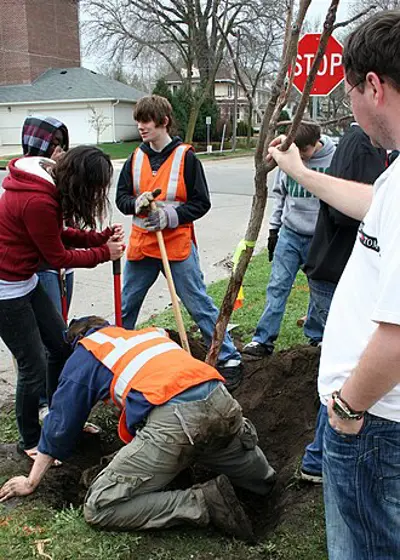
Every year on 10 October, children, teachers, foresters, town officials and ordinary volunteers across Poland pick up spades and plant trees. The day is known as Święto Drzewa, which means “Tree Day” or “Arbor Day.” It is not a public holiday, and it did not come from a king, a war or a law. It began in the early 2000s as an environmental education project and grew, one school garden at a time, into a regular part of the Polish calendar.
The core idea came from the United States, where the first Arbor Day was held in Nebraska in 1872. In Poland, the programme has been run since 2003 by the ecological organisation Klub Gaja, with the State Forests (Lasy Państwowe) as a long-time partner. A national opening ceremony takes place in Warsaw each year, while the real action happens in thousands of smaller places: schoolyards, parks, village squares and forest clearings.
A quick note on dates: some online databases file this observance under “year 0.” That is only a placeholder for a recurring day with no single founding date. What matters is the calendar day, 10 October, and the year the Polish programme began, 2003.
At a glance
- Date / period: 10 October every year; organised in its present form since 2003
- Location: Poland, with the national opening usually held in Warsaw
- Category: Environmental observance and tree-planting day
- Main participants: Klub Gaja, the State Forests, schools, local governments, government ministries and volunteers
- Outcome: An annual tradition; the organisers report more than one million trees planted between 2003 and 2025
1. Historical background
The American idea
Arbor Day began on the almost treeless plains of Nebraska. Julius Sterling Morton, a newspaper editor who had moved to Nebraska Territory in 1854, was a passionate tree lover and believed settlers needed many more of them. On 4 January 1872 he proposed a tree-planting day to the state Board of Agriculture. The board agreed, and the first Arbor Day was held on 10 April 1872. Prizes were offered to the counties and individuals who planted the most trees, and it is estimated that more than one million trees went into the ground that day. In 1874, Governor Robert Furnas officially proclaimed the day.
The idea soon spread to other American states and later to other countries. Because the best planting season depends on climate, the date differs from place to place, and many countries mark it in spring.
Trees and the law in Poland
Poland has a very old tradition of protecting trees. In its 2013 programme booklet, Klub Gaja points out that the first Polish legal rule aimed at protecting old trees was an edict protecting yew trees, issued by King Władysław Jagiełło, who ruled around the turn of the 15th century. Trees also feature in local legends and in the stories of towns and villages, which is one reason old trees are still treated as living witnesses of history.
The climate backdrop
By the late 20th and early 21st centuries, the world was paying closer attention to climate change and forests. According to Klub Gaja, the 1997 Kyoto Protocol officially accepted that forests should be part of the global strategy against climate change. In 2006 the United Nations launched the Billion Tree Campaign, a worldwide effort to get more trees planted.
Klub Gaja itself was founded in 1988 and is based in Wilkowice, in southern Poland. The organisation says it has worked on planting and protecting trees from the very start of its activity.
2. Causes and factors leading to the event
Poland’s Tree Day was not triggered by one dramatic moment. It grew out of several things coming together:
- Growing climate awareness. Planting and protecting trees was presented as a practical, easy-to-understand way for ordinary people to respond to climate change.
- A need for hands-on environmental education. The programme was designed mainly with schools and kindergartens in mind, though it is open to everyone, whatever their age, place of residence or background.
- An organisation ready to lead. Klub Gaja already had many years of experience with tree protection and campaigns.
- A partner with real expertise. Foresters from the State Forests have been involved since the first edition in 2003. They coordinate activities in local forest districts, help schools, and often provide young trees for free.
- A proven model. Arbor Day had already shown, in the United States and elsewhere, that a single symbolic day could get large numbers of people planting.
Points that are uncertain or unclear
- The start year. Klub Gaja says it launched the programme in 2003, and its edition numbers fit that date (the 22nd edition took place in 2024). A city information page from Toruń, however, says Poland has marked the day since 2002. This article follows the organiser’s date.
- The choice of 10 October. The sources reviewed for this article do not explain why this particular date was chosen. Autumn is a normal time for planting, and local events often run through October and beyond, but that is an observation, not a documented reason.
- The name. Some Polish websites call it “World Tree Day” (Światowy Dzień Drzewa) and credit Morton with the idea. The programme run by Klub Gaja is called Święto Drzewa. Morton’s original Arbor Day was held in April, so the Polish date is a local choice, not a copy of the American one.
3. What happened?
2003: the first Tree Day
Klub Gaja started the programme in 2003 as an ecological education project. It joins lessons about nature and climate with real action: planting trees and taking care of the ones that already exist. Each year the national programme opens on 10 October in Warsaw with guests and a symbolic planting. This serves as a signal to groups around the country, who organise their own events for their own communities. Participants have included schools, town councils, libraries, workplaces, hospitals and care homes.
2006–2007: joining a global campaign
After the United Nations launched its Billion Tree Campaign in 2006, the Polish programme joined it in 2007. From then on, trees planted during Tree Day were added to the worldwide total. The 2013 booklet notes that 449,953 trees in that global count came from seven editions of the Polish programme.
Three strands: planting, Tree of the Year and saving horses
Over time, the programme gained two companion projects:
- Tree of the Year (Drzewo Roku). This contest does not look for the oldest, tallest or rarest tree. It looks for loved trees, ones with a story that brings people together. The 2013 winner was the Wybicki Oak in Będomin, in northern Poland, which received more than 8,000 votes. It is linked to Józef Wybicki, who wrote the words of the Polish national anthem. By 2025 the contest had reached its 15th edition.
- Collect Waste Paper, Save Horses (Zbieraj makulaturę, ratuj konie). Schools and groups collect paper for recycling, and the money is used to buy horses that were headed for slaughter, are ill, or whose owners can no longer keep them. By 2013, Klub Gaja said 54 horses had been saved this way.
2008–2013: taking the message to climate conferences
Klub Gaja used major United Nations climate conferences to promote the idea:
- Poznań, 2008 (COP14). The organisation held a 12-day happening on Plac Wolności, where wicker figures joined hands around the only tree on the square. Klub Gaja describes it as the longest event in its history.
- Copenhagen, 2009 (COP15). Klub Gaja handed out 10,000 certified oak acorns from the Białowieża Forest, with instructions on how to plant them.
- Warsaw, 2013 (COP19). The 2013 booklet describes plans to offset the carbon dioxide produced by delegates’ travel by planting 3,500 trees across Warsaw during the 11th edition’s opening on 10 October, and to hand out 5,000 oak seeds to conference guests and residents in November.
2016 to today
The 14th edition in 2016 opened in Warsaw’s Pola Mokotowskie park, with the city’s mayor as honorary patron and the State Forests and a fleet-management company as strategic partners. Reports at the time said that about 40,000 trees had been planted during the previous edition. The 22nd edition in 2024 used the theme “Tree Day connects generations.” Cities have also built the day into their own calendars. Koszalin has made the campaign a permanent part of its municipal calendar of ecological events, and Poznań announced a full week of walks, workshops and training sessions from 10 to 17 October 2026.
4. Key people, groups and organizations
- J. Sterling Morton (1832–1902). The American editor and politician who proposed the first Arbor Day in 1872. His idea is the ancestor of every Arbor Day in the world, including Poland’s.
- Klub Gaja. The Polish ecological organisation that created and runs the programme. Jacek Bożek is its founder and president, and Jolanta Migdał coordinated the programme in 2013.
- The State Forests (Lasy Państwowe). The national forestry organisation and strategic partner. In 2013 its Director General, Adam Wasiak, said that foresters had played a key role since the first edition in 2003, coordinating local actions and teaching in schools. He added that Polish foresters plant more than 500 million trees every year.
- Government ministries. The 2013 booklet carries messages of support from the ministers of environment and education. The programme was also recommended by the Ministry of Environment as a good educational practice during the COP14 and COP19 climate conferences.
- Schools, local governments and volunteers. The people who do the actual planting. Their choices shape each local celebration, from a single sapling in a kindergarten garden to thousands of trees in a forest.
- The United Nations. Through its Billion Tree Campaign, it gave the programme a global frame of reference.
5. Outcome and immediate consequences
The most visible result is simple: trees in the ground. Klub Gaja reported that after ten years, nearly 502,000 people had taken part and had planted about 570,000 trees, along with collecting more than 2,700 tonnes of waste paper. After 17 years, the figures had grown to almost 700,000 participants, over 930,000 trees and more than 5,050 tonnes of paper.
The programme also changed how local places looked and worked. Free saplings from forest districts made it easy for schools to join. The 2013 booklet gives examples such as students in Czeladź planting trees on spoil heaps left by a former coal mine, and a special school in Stargard Szczeciński planting 8,000 young beech trees in a forest near Smogolice. In many schools, Tree Day became a yearly tradition passed from one group of pupils to the next.
6. Historical significance and long-term impact
Poland’s Tree Day matters for several reasons:
- It turned an international idea into a local habit. Instead of staying a slogan, Arbor Day became something families and classrooms do with their hands.
- It lasted. Many environmental campaigns fade after a year or two. This one has been repeated every year since 2003.
- It linked local action to global goals. Through the UN campaign and the climate conferences, small school plantings were presented as part of a worldwide effort.
- It reached a wide mix of people. The programme’s own examples include hospitals, special schools, libraries, village fire brigades, scout troops and city offices.
- It added to Poland’s environmental culture. Along with tree planting, it encouraged people to look after old trees, search for natural monuments and learn the stories of trees in their own neighbourhoods.
- It grew steadily. From about 570,000 trees in the first decade to more than one million reported by 2025, the programme shows lasting public interest.
7. Legacy and historical interpretations
Klub Gaja presents tree planting as one of the most cost-effective ways of reducing the effects of climate change, and it frames Tree Day as both an environmental and a social project: planting trees, but also building cooperation between schools, councils, businesses and neighbours. That is an organiser’s view, and it is fair to read it as such.
It helps to keep the numbers in perspective. In 2013, the head of the State Forests said foresters plant over 500 million trees a year in Polish forests, while the whole Tree Day programme reported around 570,000 trees across its first ten years. In other words, the programme’s forestry impact is small compared with regular forestry work. Its value, by the organisers’ own account, lies more in education, community involvement and public awareness than in the raw count of trees.
The observance also shows how a modern tradition can be created from the ground up. Unlike many national days, Tree Day was not established by a government decision. It was built by a non-governmental organisation and spread through schools and local institutions. That is also why small differences in how it is described, such as the start year or the “World Tree Day” label, still appear in local sources.
8. Timeline of important developments
- 4 January 1872: J. Sterling Morton proposes a tree-planting day to the Nebraska State Board of Agriculture.
- 10 April 1872: The first Arbor Day is held in Nebraska; more than one million trees are estimated to have been planted.
- 1874: Governor Robert Furnas officially proclaims Arbor Day in Nebraska.
- 1988: Klub Gaja is founded.
- 1997: The Kyoto Protocol is adopted; Klub Gaja notes that it recognised forests as part of the climate strategy.
- 2003: Klub Gaja starts the Święto Drzewa programme in Poland.
- 2006: The United Nations launches the Billion Tree Campaign.
- 2007: The Polish programme joins the campaign.
- 2008: Klub Gaja holds a 12-day happening during the COP14 climate conference in Poznań.
- 2009: Klub Gaja gives out 10,000 oak acorns at COP15 in Copenhagen.
- 10 October 2013: The 11th edition opens in Warsaw ahead of the COP19 climate conference; after ten years, the programme reports about 570,000 trees planted.
- 2024: The 22nd edition is held under the theme “Tree Day connects generations.”
- 2025: Klub Gaja reports more than one million trees planted through the programme since 2003.
9. Frequently asked questions
What caused Arbor Day in Poland?
No single event caused it. It grew from the American Arbor Day model, rising concern about climate change, the work of Klub Gaja and the support of Polish foresters, who wanted a simple way to involve young people in planting and protecting trees.
When and where does Arbor Day in Poland happen?
It is held on 10 October every year. The national opening takes place in Warsaw, and local events happen across the country. Some local groups hold their planting a little earlier or later in autumn. The programme’s organisers date its start to 2003, although one local source says 2002.
What was the outcome of Arbor Day in Poland?
It became a lasting yearly tradition. The organisers report about 570,000 trees planted in the first ten years and more than one million between 2003 and 2025, along with school traditions, a Tree of the Year contest and a paper-collection campaign to save horses.
Why is Arbor Day in Poland important in history?
It is an example of citizens, schools and foresters turning a global environmental idea into a long-running local custom. Its importance lies in education and community action more than in its tree count alone.
Conclusion
Arbor Day in Poland is a young tradition built on an old idea. Morton’s 1872 tree-planting day in Nebraska gave the world a model, and from 2003 Klub Gaja and the State Forests adapted it for Polish schools and communities. Over the years the programme added a Tree of the Year contest, took part in the UN Billion Tree Campaign and carried its message to international climate conferences. Its trees are only a small part of Poland’s forests, but its lasting contribution is a yearly habit of planting, caring and learning together.
References and further reading
- Klub Gaja, Święto Drzewa 2013 (programme booklet), Klub Gaja, 2013 — https://archiwum.swietodrzewa.pl/wp-content/uploads/2016/07/SD_broszura_2013.pdf
- Klub Gaja, Święto Drzewa 2013 (leaflet), Klub Gaja, 2013 — https://archiwum.swietodrzewa.pl/wp-content/uploads/2013/10/ulotka_-swieto_-drzewa_-2013.pdf
- Arbor Day Foundation, The History of Arbor Day — https://arborday.org/celebrate/history.cfm
- Encyclopaedia Britannica, Arbor Day — https://www.britannica.com/topic/Arbor-Day
- Encyclopaedia Britannica, J. Sterling Morton — https://www.britannica.com/biography/J-Sterling-Morton
- Curt Arens, How did Arbor Day begin?, Nebraska Farmer, 30 April 2021 — https://www.farmprogress.com/conservation/how-did-arbor-day-begin
- Lasy Państwowe (Dynów Forest District), 10 października – Dzień Drzewa! — https://dynow.krosno.lasy.gov.pl/en/polskie-lasy/-/asset_publisher/x9eK/content/10-pazdziernika-dzien-drzewa
- Klub Gaja, 22. Święto Drzewa – przyłącz się!, published 30 September 2024 on the Nowe Miasto County portal — https://samorzad.gov.pl/web/powiat-nowomiejski/22-swieto-drzewa--przylacz-sie
- National Geographic Polska, Oto polskie Drzewo Roku 2025 — https://www.national-geographic.pl/przyroda/oto-polskie-drzewo-roku-2025-na-zwyciezce-zaglosowalo-niemal-8-tys-internautow/
- Klub Gaja, public benefit organisation profile (KRS 0000120069), e-pity.pl — https://www.e-pity.pl/pit-2017-program-online-epity-2018-KRS-0000120069
- Paula Zych, Zbliża się nietypowe święto ekologiczne, epoznan.pl, 1 October 2026 — https://epoznan.pl/news-news-180510-zbliza_sie_nietypowe_swieto_ekologiczne_poznan_bedzie_z_tej_okazji_swietowal_az_tydzien



Comments 0
Sign in to join the discussion.