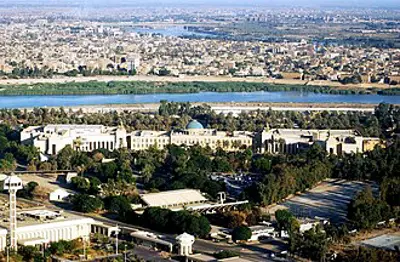
Baghdad is the capital and largest city in Iraq. It is located on the banks of the Tigris in central Iraq. The city has an estimated population of 8 million. It ranks among the most populous and largest cities in the Middle East and the Arab world and constitutes 22% of Iraq's population. Baghdad is a primary financial and commercial center in the region.
At a conference held in Baghdad, the governments of Iran, Iraq, Kuwait, Saudi Arabia, and Venezuela founded OPEC to help coordinate their petroleum policies and influence global oil prices.
On September 14, in the year 1960, At a conference held in Baghdad, the governments of Iran, Iraq, Kuwait, Saudi Arabia, and Venezuela founded OPEC to help coordinate their petroleum policies and influence global oil prices. This event is recorded as a Selected Events event in the history of September 14, one of 502 recorded events on this date across all of history.
Key Facts
- This event took place on September 14, 1960 (AD era).
- It is categorised as a Selected Events event in recorded history.
- Referenced in 3 Wikipedia articles.
- The event is associated with a specific geographical location (see map below).
- Wikipedia source last updated on 29 August 2026.
On This Date in History 502
This article draws on content from Wikipedia, available under CC BY-SA 4.0.
More on September 14

2015
Physicists of the LIGO and Virgo projects first observed gravitational waves, the existence of which was predicted by…
The Laser Interferometer Gravitational-Wave Observatory (LIGO) is a large-scale physics experiment and observatory designed to detect cosmic gravitational waves. Prior to LIGO, al…
Physicists of the LIGO and Virgo projects first observed gravitational waves, the existence of which was predicted by…

2003
President Kumba Ialá (pictured) of Guinea-Bissau was deposed in a bloodless military coup.
Kumba Yalá Embaló, also spelled Ialá, was a Bissau-Guinean politician who was president from 17 February 2000 until he was deposed in a bloodless military coup on 14 September 200…
President Kumba Ialá (pictured) of Guinea-Bissau was deposed in a bloodless military coup.
1943
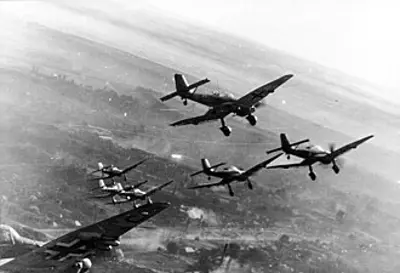
World War II: Nazi forces began a mass extermination campaign against the civilian residents of around 20 villages on…
World War II, or the Second World War, was a global conflict between two coalitions: the Allies and the Axis powers. Nearly all of the world's countries participated, with many en…
World War II: Nazi forces began a mass extermination campaign against the civilian residents of around 20 villages on…
1940
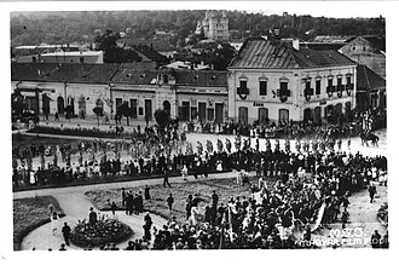
Hungarian forces massacred at least 150 ethnic Romanians in Ip, Transylvania, following rumors that Romanians were…
The Ip massacre was the mass killing of around 150 ethnic Romanians by the Royal Hungarian Army on 14 September 1940, in Ipp,, Northern Transylvania, and in nearby locations and s…
Hungarian forces massacred at least 150 ethnic Romanians in Ip, Transylvania, following rumors that Romanians were…
1752
Under the terms of the Calendar (New Style) Act 1750, the British Empire adopted the Gregorian calendar, skipping…
The Calendar Act 1750, also known as Chesterfield's Act or the British Calendar Act of 1751, is an act of the Parliament of Great Britain. Its purpose was for Great Britain and th…
Under the terms of the Calendar (New Style) Act 1750, the British Empire adopted the Gregorian calendar, skipping…
2019
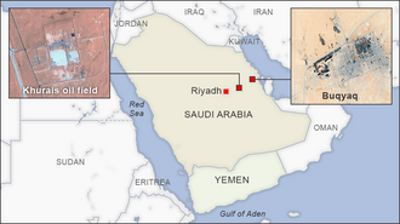
Drone attacks on major processing facilities at Abqaiq and Khurais forced Saudi Arabia to cut more than half of its…
On 14 September 2019, drones were used to attack oil processing facilities at Abqaiq and Khurais in eastern Saudi Arabia. The facilities were operated by Saudi Aramco, the country…
Drone attacks on major processing facilities at Abqaiq and Khurais forced Saudi Arabia to cut more than half of its…
Comments 0
Sign in to join the discussion.