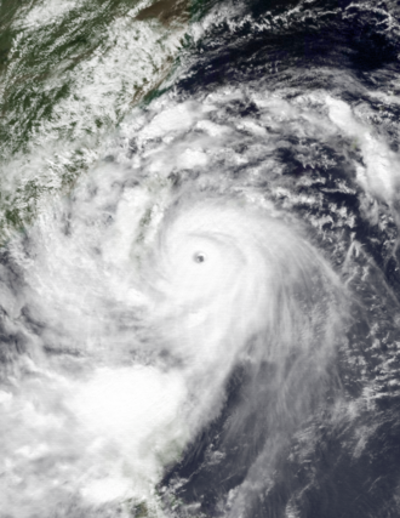
Typhoon Sarah, known in the Philippines as Typhoon Openg, was a powerful typhoon that caused extensive damage along an erratic path across the Western Pacific in September 1989. Originating from a disturbance within a monsoon trough in early September, Sarah was first classified as a tropical depression near the Mariana Islands on September 5. Moving quickly westward, the depression soon strengthened into Tropical Storm Sarah. On September 8, the storm abruptly turned southward and temporarily attained typhoon status. Following a series of interactions with secondary areas of low pressure, the storm turned northward the following day. By September 11, Sarah entered a region favoring development and underwent a period of explosive intensification. At the end of this phase, the storm attained its peak intensity as a Category 4–equivalent typhoon on the Saffir–Simpson Hurricane Scale. The typhoon subsequently weakened rapidly and made two landfalls in Taiwan by September 12. After moving over the Taiwan Strait, Sarah made its final landfall in Eastern China on September 13 before dissipating the following day.
Typhoon Sarah dissipated after causing extensive damage along an erratic path across the Western Pacific, killing 71 in Taiwan, the Philippines, and the Gotō Islands.
On September 14, in the year 1989, Typhoon Sarah dissipated after causing extensive damage along an erratic path across the Western Pacific, killing 71 in Taiwan, the Philippines, and the Gotō Islands. This event is recorded as a Selected Events event in the history of September 14, one of 495 recorded events on this date across all of history.
Key Facts
- This event took place on September 14, 1989 (AD era).
- It is categorised as a Selected Events event in recorded history.
- Referenced in 2 Wikipedia articles.
- Wikipedia source last updated on 1 May 2026.
On This Date in History 495
This article draws on content from Wikipedia, available under CC BY-SA 4.0.
More on September 14

Physicists of the LIGO and Virgo projects first observed gravitational waves, the existence of which was predicted by…
The Laser Interferometer Gravitational-Wave Observatory (LIGO) is a large-scale physics experiment and observatory designed to detect cosmic gravitational waves. Prior to LIGO, al…
Physicists of the LIGO and Virgo projects first observed gravitational waves, the existence of which was predicted by…

President Kumba Ialá (pictured) of Guinea-Bissau was deposed in a bloodless military coup.
Kumba Yalá Embaló, also spelled Ialá, was a Bissau-Guinean politician who was president from 17 February 2000 until he was deposed in a bloodless military coup on 14 September 200…
President Kumba Ialá (pictured) of Guinea-Bissau was deposed in a bloodless military coup.
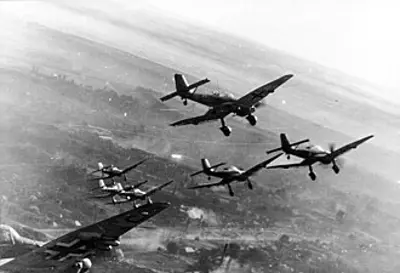
World War II: Nazi forces began a mass extermination campaign against the civilian residents of around 20 villages on…
World War II, or the Second World War, was a global conflict between two coalitions: the Allies and the Axis powers. Nearly all of the world's countries participated, with many en…
World War II: Nazi forces began a mass extermination campaign against the civilian residents of around 20 villages on…
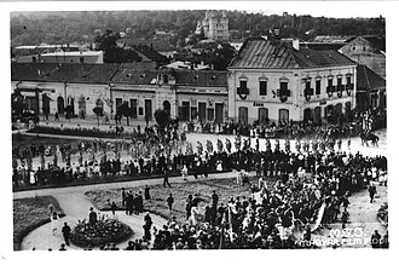
Hungarian forces massacred at least 150 ethnic Romanians in Ip, Transylvania, following rumors that Romanians were…
The Ip massacre was the mass killing of around 150 ethnic Romanians by the Royal Hungarian Army on 14 September 1940, in Ipp,, Northern Transylvania, and in nearby locations and s…
Hungarian forces massacred at least 150 ethnic Romanians in Ip, Transylvania, following rumors that Romanians were…

Under the terms of the Calendar (New Style) Act 1750, the British Empire adopted the Gregorian calendar, skipping…
The Calendar Act 1750, also known as Chesterfield's Act or the British Calendar Act of 1751, is an act of the Parliament of Great Britain. Its purpose was for Great Britain and th…
Under the terms of the Calendar (New Style) Act 1750, the British Empire adopted the Gregorian calendar, skipping…
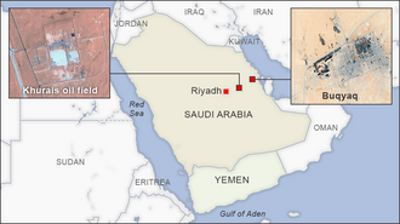
Drone attacks on major processing facilities at Abqaiq and Khurais forced Saudi Arabia to cut more than half of its…
On 14 September 2019, drones were used to attack oil processing facilities at Abqaiq and Khurais in eastern Saudi Arabia. The facilities were operated by Saudi Aramco, the country…
Drone attacks on major processing facilities at Abqaiq and Khurais forced Saudi Arabia to cut more than half of its…
Comments 0
Sign in to join the discussion.