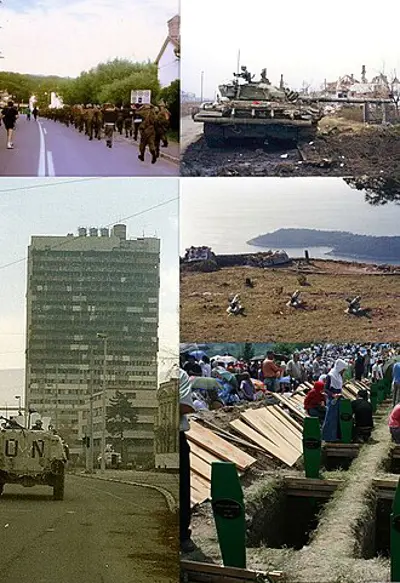
The Yugoslav Wars were a series of separate but related ethnic conflicts, wars of independence, and insurgencies that took place from 1991 to 2001 in what had been the Socialist Federal Republic of Yugoslavia. The conflicts both led up to and resulted from the breakup of Yugoslavia, which began in mid-1991, into six independent countries matching the six republics that had previously constituted Yugoslavia: Slovenia, Croatia, Bosnia and Herzegovina, Montenegro, Serbia, and Macedonia, which was later renamed to North Macedonia. The breakup of Yugoslavia and the accompanying Yugoslav Wars are commonly attributed to increasing nationalism and unresolved ethnic tensions in Yugoslavia. While most of the conflicts ended through peace accords that involved full international recognition of the new states, they resulted in the deaths of many as well as severe economic damage to the region.
Yugoslav Wars: The city of Knin, Croatia, a significant Serb stronghold, is taken by Croatian forces during Operation Storm. The date is celebrated in Croatia as Victory Day.
On August 5, in the year 1995, Yugoslav Wars: The city of Knin, Croatia, a significant Serb stronghold, is taken by Croatian forces during Operation Storm. The date is celebrated in Croatia as Victory Day. This event is recorded as a Historical Events event in the history of August 5, one of 467 recorded events on this date across all of history.
Key Facts
- This event took place on August 5, 1995 (AD era).
- It is categorised as a Historical Events event in recorded history.
- Referenced in 6 Wikipedia articles.
- Wikipedia source last updated on 28 July 2026.
On This Date in History 467
This article draws on content from Wikipedia, available under CC BY-SA 4.0.
More on August 5
The last major Danish army to raid England for nearly a century is defeated at the Battle of Tettenhall by the allied…
The Kingdom of England was a sovereign state on the island of Great Britain from 927, when all of the Anglo-Saxon kingdoms were united under the rule of Æthelstan, until 1 May 170…
The last major Danish army to raid England for nearly a century is defeated at the Battle of Tettenhall by the allied…
Battle of Maserfield: Penda of Mercia defeats and kills Oswald of Northumbria.
The Battle of Maserfield, was fought on 5 August 641 or 642 between the Anglo-Saxon kings Oswald of Northumbria and Penda of Mercia allied with Welsh Kingdom of Gwynedd, ending in…
Battle of Maserfield: Penda of Mercia defeats and kills Oswald of Northumbria.

Fires resulting from the destruction of the Second Temple in Jerusalem are extinguished.
AD 70 (LXX) was a common year starting on Monday of the Julian calendar. At the time, it was known as the Year of the Consulship of Vespasian and Titus. The denomination AD 70 for…
Fires resulting from the destruction of the Second Temple in Jerusalem are extinguished.

Guangwu claims the throne as Emperor of China, restoring the Han dynasty after the collapse of the short-lived Xin…
The 20s decade ran from January 1, AD 20, to December 31, AD 29.
Guangwu claims the throne as Emperor of China, restoring the Han dynasty after the collapse of the short-lived Xin…

Following the non-cooperation movement against the government of Bangladesh, Bangladeshi prime minister Sheikh Hasina…
The non-cooperation movement, also known as the one-point movement, was a disinvestment movement and a mass uprising against the Awami League-led government of Bangladesh, initiat…
Following the non-cooperation movement against the government of Bangladesh, Bangladeshi prime minister Sheikh Hasina…

Australia's second most populous state Victoria enters its sixth COVID-19 lockdown, enacting stage four restrictions…
Australia, officially the Commonwealth of Australia, is a country comprising the mainland of the Australian continent, the island of Tasmania and numerous smaller islands. It has …
Australia's second most populous state Victoria enters its sixth COVID-19 lockdown, enacting stage four restrictions…

Comments 0
Sign in to join the discussion.