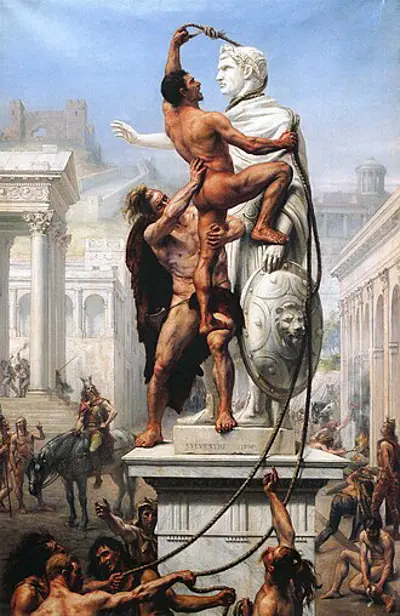
The sack of Rome on 24 August 410 AD was undertaken by the Visigoths led by their king, Alaric. At that time, Rome was no longer the administrative capital of the Western Roman Empire, having been replaced first by Mediolanum in 286 and then by Ravenna in 402. Nevertheless, the city of Rome retained a paramount position as "the eternal city" and a spiritual center of the Empire. This was the first time in almost 800 years that Rome had fallen to a foreign enemy, and the sack was a major shock to contemporaries, friends and foes of the Empire alike.
Rome was sacked for the first time in approximately 800 years by the Visigoths under Alaric I.
On August 24, in the year 410, Rome was sacked for the first time in approximately 800 years by the Visigoths under Alaric I. This event is recorded as a Selected Events event in the history of August 24, one of 423 recorded events on this date across all of history.
Key Facts
- This event took place on August 24, 410 (AD era).
- It is categorised as a Selected Events event in recorded history.
- Referenced in 3 Wikipedia articles.
- Wikipedia source last updated on 20 May 2026.
On This Date in History 423
This article draws on content from Wikipedia, available under CC BY-SA 4.0.
More on August 24

2006
20 years ago
The International Astronomical Union passed a resolution redefining the term planet and classifying Pluto as a dwarf…
The International Astronomical Union is an international non-governmental organization (INGO) with the objective of advancing astronomy in all aspects, including promoting astrono…
The International Astronomical Union passed a resolution redefining the term planet and classifying Pluto as a dwarf…
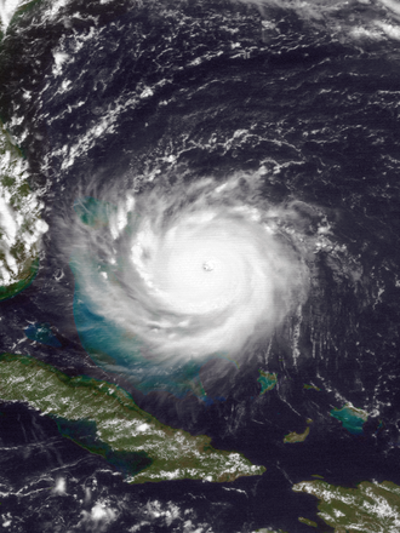
1992
Hurricane Andrew, the third-most intense Category 5 cyclone to impact the United States in the 20th century, made…
Hurricane Andrew was the most destructive hurricane to ever hit Florida in terms of structures damaged or destroyed, and remained the costliest in financial terms until Hurricane …
Hurricane Andrew, the third-most intense Category 5 cyclone to impact the United States in the 20th century, made…

1966
60 years ago
Cultural Revolution: Red Guards vandalised the Jokhang (depicted), the holiest Buddhist temple in Tibet.
The Cultural Revolution, formally known as the Great Proletarian Cultural Revolution, was a sociopolitical movement in the People's Republic of China (PRC). It was launched by CCP…
Cultural Revolution: Red Guards vandalised the Jokhang (depicted), the holiest Buddhist temple in Tibet.
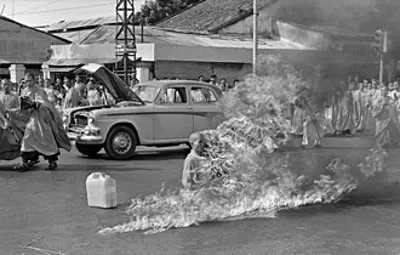
1963
Buddhist crisis: The U.S. State Department ordered Ambassador Henry Cabot Lodge Jr. (pictured) to encourage South…
The Buddhist crisis was a period of political and religious tension in South Vietnam between May and November 1963, characterized by a series of repressive acts by the South Vietn…
Buddhist crisis: The U.S. State Department ordered Ambassador Henry Cabot Lodge Jr. (pictured) to encourage South…
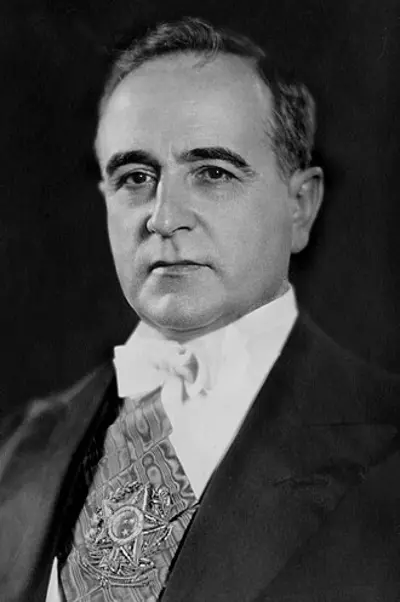
1954
In the midst of a political crisis, Brazilian president Getúlio Vargas fatally shot himself in the Catete Palace in…
Getúlio Dornelles Vargas was a Brazilian military officer, lawyer, and politician who served as the 14th and 17th president of Brazil, from 1930 to 1945 and from 1951 until his su…
In the midst of a political crisis, Brazilian president Getúlio Vargas fatally shot himself in the Catete Palace in…

1942
World War II: At the Battle of the Eastern Solomons, bombers from the U.S. aircraft carrier Saratoga sank the Japanese…
World War II, or the Second World War, was a global conflict between two coalitions: the Allies and the Axis powers. Nearly all of the world's countries participated, with many en…
World War II: At the Battle of the Eastern Solomons, bombers from the U.S. aircraft carrier Saratoga sank the Japanese…

Comments 0
Sign in to join the discussion.