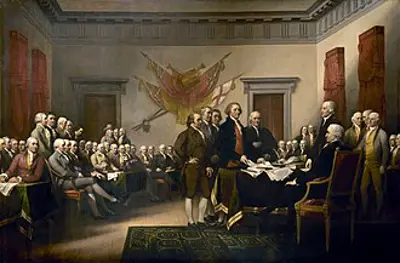
American Revolution: Samuel Huntington is elected President of the Continental Congress, succeeding John Jay.


32 results for “Samuel Doe” — type: events (29 ms)
American Revolution: Samuel Huntington is elected President of the Continental Congress, succeeding John Jay.
Mount Hood (Oregon) is named after Samuel Hood, 1st Viscount Hood by Lt. William E. Broughton who sighted the mountain near the mouth of the Willamette River.
The United States Marine Corps is founded at Tun Tavern in Philadelphia by Samuel Nicholas.
Samuel Goldwyn and Edgar Selwyn establish Goldwyn Pictures.
The U.S. Supreme Court rules in the Baze v. Rees decision that execution by lethal injection does not violate the Eighth Amendment ban against cruel and unusual punishment.
A hand grenade thrown by Vladimir Arutyunian lands about 20 m from U.S. President George W. Bush while he is giving a speech to a crowd in Tbilisi, Georgia, but it malfunctions and does not detonate.
�s Security Council Resolution 425, 22 years after its issuance, and completely withdrew from Lebanon. The Resolution does not encompass the Shebaa farms, which is claimed by Israel, Syria and Lebanon.
�ps begins landing at Daiquirí, Cuba, about 16 miles (26 km) east of Santiago de Cuba. Lt. Gen. Arsenio Linares y Pombo of the Spanish Army outnumbers them two-to-one, but does not oppose the landings.
�nization, the U.S. Supreme Court rules that the U.S. Constitution does not assign the authority to regulate abortions to the federal government, thereby returning such authority to the individual stat�
�a message had been sent to the Allies accepting the terms of the Potsdam Declaration provided that it "does not comprise any demand that prejudices the prerogatives of the Emperor as sovereign ruler."
American Civil War: Battle of Brice's Crossroads: Confederate troops under Nathan Bedford Forrest defeat a much larger Union force led by General Samuel D. Sturgis in Mississippi.
�in Massachusetts. The British offer a pardon to all colonists who lay down their arms. There would be only two exceptions to the amnesty: Samuel Adams and John Hancock, if captured, were to be hanged.