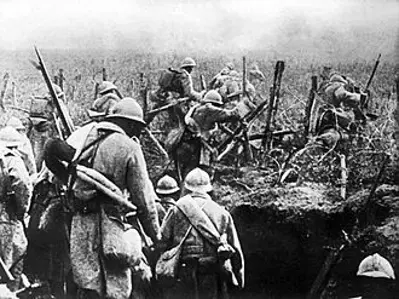
World War I: Private Thomas Highgate becomes the first British soldier to be executed for desertion during the war.

4175 results for “Thomas H. Ince” — type: events (726 ms)
World War I: Private Thomas Highgate becomes the first British soldier to be executed for desertion during the war.
Thomas Cavendish in his ship Desire enters Plymouth and completes the first deliberately planned voyage of circumnavigation.
Thomas Edison's first commercial hydroelectric power plant, the Vulcan Street Plant, begins operation.
Prof. Anita Hill delivers her televised testimony concerning sexual harassment during the Clarence Thomas Supreme Court nomination.
Thomas Edison applies for a patent for his design for an incandescent light bulb.
A cartoon by Thomas Nast in Harper's Weekly, is considered the first important use of an elephant as a symbol for the United States Republican Party.
Thomas Edison announces his invention of the phonograph, a machine that can record and play sound.
Thomas Edison demonstrates his phonograph for the first time.
Insurgent peasants led by Anabaptist pastor Thomas Müntzer were defeated at the Battle of Frankenhausen, ending the German Peasants' War in the Holy Roman Empire.
American War of Independence: British general Thomas Gage declares martial law in Massachusetts. The British offer a pardon to all colonists who lay down their arms. There would be only two exceptions�
American Revolutionary War: Thomas Hickey, Continental Army private and bodyguard to General George Washington, is hanged for mutiny and sedition.
Thomas Howard, 4th Duke of Norfolk, is arrested for his role in the Ridolfi plot to assassinate Queen Elizabeth I of England and replace her with Mary, Queen of Scots.
Using a filament of carbonized thread, Thomas Edison tests the first practical electric incandescent light bulb; the bulb lasted 131⁄2 hours before burning out.
Thomas Blood, disguised as a clergyman, attempts to steal England's Crown Jewels from the Tower of London.
London playwright Thomas Kyd is arrested and tortured by the Privy Council for libel.
Sir Thomas More resigns as Lord Chancellor of England.
Shakespeare's sonnets are first published in London, perhaps illicitly, by the publisher Thomas Thorpe.
The Continental Congress appoints Thomas Jefferson, John Adams, Benjamin Franklin, Roger Sherman, and Robert R. Livingston to the Committee of Five to draft a declaration of independence.
Thomas Willett is appointed the first mayor of New York City.