Civil rights movement: U.S. President Lyndon B. Johnson signs the Civil Rights Act of 1964 meant to prohibit…
Civil rights movement: U.S. President Lyndon B. Johnson signs the Civil Rights Act of 1964 meant to prohibit segregation in public places.
3038 results for “South African Airways Flight 228 crashes near J” — type: events (922 ms)
Civil rights movement: U.S. President Lyndon B. Johnson signs the Civil Rights Act of 1964 meant to prohibit segregation in public places.
Charles J. Guiteau shoots and fatally wounds U.S. President James A. Garfield (who will die of complications from his wounds on September 19).
Battle of Brissarthe: The Franks led by Robert the Strong are defeated by a joint Breton-Viking army.
Li Shimin, the future Emperor Taizong of Tang, ambushes and kills his rival brothers Li Yuanji and Li Jiancheng in the Xuanwu Gate Incident.
British Prime Minister John Major announced the Stone of Scone would be returned to Scotland.
U.S. President Jimmy Carter signs the first directive for secret aid to the opponents of the pro-Soviet regime in Kabul.
Dow Jones & Company publishes its first stock average.
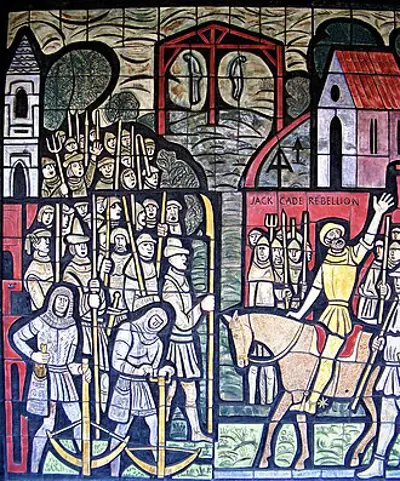
Jack Cade and his followers enter London unhindered by the government of king Henry VI.
Japan launches the Nozomi probe to Mars, joining the United States and Russia as a space exploring nation.
Three Iranian diplomats and a journalist are kidnapped in Lebanon by Phalange forces, and their fate remains unknown.
The George Jackson Brigade plants a bomb at the main power substation for the Washington state capitol in Olympia, in solidarity with a prison strike at the Walla Walla State Penitentiary Intensive Se�
Barbados, Guyana, Jamaica, and Trinidad and Tobago sign the Treaty of Chaguaramas in Chaguaramas, Trinidad and Tobago establishing the Caribbean Community (CARICOM). It replaces the Caribbean Free Tra�
U.S. President Lyndon B. Johnson signs the Freedom of Information Act into United States law. The act went into effect the next year.
Cold War: A court in Czechoslovakia sentences American journalist William N. Oatis to ten years in prison on charges of espionage.
William Shockley announces the invention of the junction transistor.
The Kielce pogrom against Jewish Holocaust survivors in Poland.
Western Samoa changes the International Date Line, causing Monday (July 4) to occur twice, resulting in a leap year with 367 days.
The founder of Pakistan, Quaid-i-Azam Muhammad Ali Jinnah, joins Sindh-Madrasa-tul-Islam, Karachi.
Grand Junction Railway, the world's first long-distance railway, opens between Birmingham and Liverpool.
John Neal delivers the first public lecture in the US to advocate the rights of women.