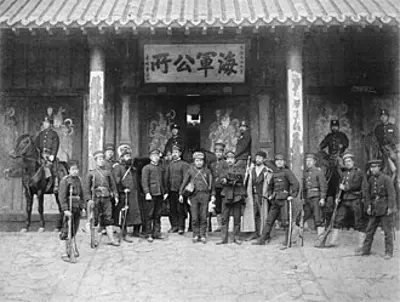
Russo-Japanese War: The Japanese battleships Hatsuse and Yashima sank after striking several mines off Port Arthur, Chin
Russo-Japanese War: The Japanese battleships Hatsuse and Yashima sank after striking several mines off Port Arthur, China.
1699 results for “Shoshichi Kobayashi, Japanese-American mathematician and academic (born 1932)” — type: selected (2446 ms)
Russo-Japanese War: The Japanese battleships Hatsuse and Yashima sank after striking several mines off Port Arthur, China.
First Sino-Japanese War: After capturing the Chinese city of Port Arthur, the Japanese army began a massacre of the city's soldiers and civilians.
World War II: Amid a Soviet invasion of Japanese-held Sakhalin, Japanese police massacred 18 Koreans in Kamishisuka.
World War II: American forces defeated the Japanese at the Third Battle of the Matanikau in Guadalcanal, Solomon Islands, reversing the Japanese victory a couple of weeks earlier.
In a paper presented to the Royal Astronomical Society, English mathematician Charles Babbage proposed a difference engine (pictured), an automatic, mechanical calculator designed to tabulate polynomi�
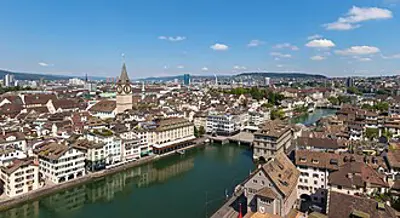
The first meeting of the International Congress of Mathematicians was held in Zürich, Switzerland.
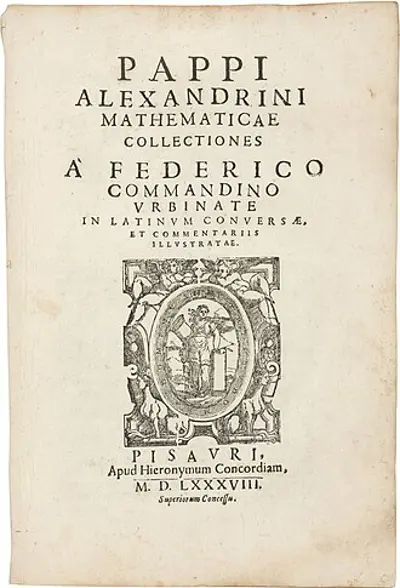
Pappus of Alexandria, one of the last great Greek mathematicians of antiquity, observed an eclipse that allowed historians to calculate the approximate dates of his life.
English mathematician Alan Turing published the first details of the Turing machine, an abstract device that can simulate the logic of any computer algorithm by manipulating symbols.
The Japanese-run camp at Batu Lintang in Borneo was liberated by the Australian 9th Division, averting the planned massacre of its 2,000-plus Allied POWs and civilian internees by four days.
World War II: Japanese troops overcame fierce American and Philippine resistance to win the Battle of Corregidor.
World War II: American and Australian forces landed on the Japanese-occupied island of Morotai.
A four-day air battle over Taiwan ended with a decisive American victory, destroying hundreds of Japanese aircraft and military facilities.
World War II: The Battle of Saipan concluded after a mass Japanese suicide attack was repelled by American forces.
The Civil Liberties Act of 1988 became law, authorizing reparations to surviving Japanese Americans interned during World War II.
Manzanar (pictured), a camp in California for the internment of Japanese Americans during World War II, was closed.
World War II: Following the American capture of Makin Atoll, USS Liscome Bay was sunk by a torpedo from Japanese submarine I-175, killing 644.
World War II: The Japanese battleship Musashi, one of the heaviest and most powerfully armed ever constructed, was sunk by American aircraft during the Battle of Leyte Gulf.
Second World War: Japanese forces began an invasion of Tulagi and nearby islands in the British Solomon Islands, enabling them to threaten and intercept supply and communication routes between the Uni�
The Act on National Flag and Anthem was adopted, formally establishing the Hinomaru and "Kimigayo" as the Japanese national flag and anthem, respectively.
World War II: The Battle of Midway, a major battle of the Pacific War, began with a massive Japanese offensive on American forces on Midway Atoll.