King Stefan Uroš III, after months of anarchy, surrenders to his son and rival Stefan Dušan, who succeeds as King of…
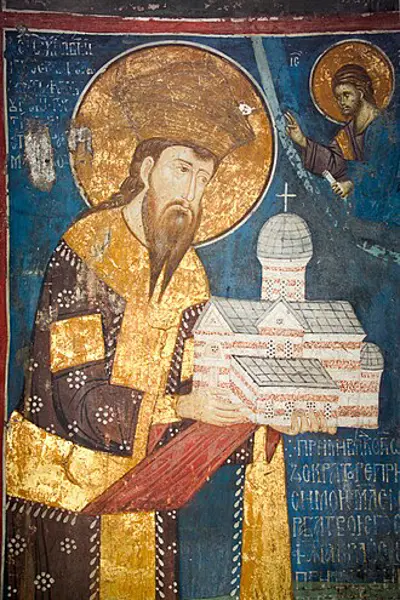
King Stefan Uroš III, after months of anarchy, surrenders to his son and rival Stefan Dušan, who succeeds as King of Serbia.
103 results for “Stefan Filipkiewicz, Polish painter (died 1944)” — type: events (544 ms)
King Stefan Uroš III, after months of anarchy, surrenders to his son and rival Stefan Dušan, who succeeds as King of Serbia.
Stefan Dušan, "the Mighty", is crowned Emperor of the Serbs at Skopje, his empire occupying much of the Balkans.
Serbian King Stefan Uroš I and the Republic of Venice sign a peace treaty.
�ose the decisions of the Congress of Berlin and the Treaty of San Stefano, as a consequence of which the Albanian lands in the Balkans were being partitioned and given to the neighbor states of Serbia�
Start of the Congress of Berlin in which the major powers of Europe revise the Treaty of San Stefano, signed on March 3 the same year, that Russia had imposed on a defeated Ottoman Empire.
Friedrich Barbarossa arrives at Niš, the capital of Serbian King Stefan Nemanja, during the Third Crusade.
Polish–Lithuanian War: The Polish Army launches the Vilna offensive to capture Vilnius in modern Lithuania.
Polish–Soviet War: Kyiv offensive: Polish troops led by Józef Piłsudski and Edward Rydz-Śmigły and assisted by a symbolic Ukrainian force capture Kyiv only to be driven out by the Red Army counter-off�
Polish–Soviet War: The Polish army under General Edward Rydz-Śmigły celebrates its capture of Kiev with a victory parade on Khreshchatyk.
Solidarity's victory in the 1989 Polish legislative election occurs, the first election since the Communist Polish United Workers' Party abandoned its monopoly of power. It sparks off the Revolutions�
Nazi crimes against the Polish nation: Nazi troops massacre Polish scientists and writers in the captured Ukrainian city of Lviv.
The Battle of Klushino is fought between forces of the Polish–Lithuanian Commonwealth and Russia during the Polish–Russian War, after which Polish troops entered Moscow.
Polish–Soviet War: A decisive Polish victory in the Battle of Komarów.
Polish–Ottoman War: The Ottoman Empire defeats the Polish–Lithuanian Commonwealth during the Battle of Cecora.
World War I: A new Polish government in western Galicia is established, triggering the Polish–Ukrainian War.
World War II: Sachsenhausen concentration camp is liberated by soldiers of the Red Army and Polish First Army.
The Constitution of May 3 (the first modern constitution in Europe) is proclaimed by the Sejm of Polish–Lithuanian Commonwealth.
World War II: Norwegian, French, Polish and British forces recapture Narvik in Norway. This is the first Allied infantry victory of the War.