Henry Carey, 2nd Earl of Monmouth, English politician (born 1595)
Sir Henry Carey, 2nd Earl of Monmouth, KB was an English nobleman and translator.
Henry Carey, 2nd Earl of Monmouth, English politician (born 1595)
Explore 145 historical events from 1660β1669.
Sir Henry Carey, 2nd Earl of Monmouth, KB was an English nobleman and translator.
Henry Carey, 2nd Earl of Monmouth, English politician (born 1595)
Andrea Sacchi was an Italian painter of High Baroque Classicism, active in Rome. A generation of artists who shared his style of art include the painters Nicolas Poussin and Giovan…
Andrea Sacchi, Italian painter (born 1599)
Sir Hugh Speke, 1st Baronet was an English politician who sat in the House of Commons in 1661.
Sir Hugh Speke, 1st Baronet
Jin Shengtan, original name Jin Renrui (金人瑞), also known as Jin Kui (金喟), was a Chinese editor, writer and critic, who has been called the champion of Vernacular Chinese literature…
Jin Shengtan, Chinese journalist and critic (born 1608)
Thomas Fuller was an English churchman and historian. He is now remembered for his writings, particularly his Worthies of England, published in 1662, after his death. He was a prol…
Thomas Fuller, English historian and author (born 1608)
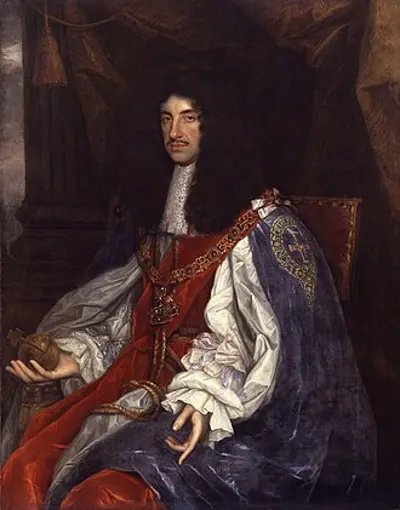
Charles II was King of Scotland from 1649 until 1651 and King of England, Scotland, and Ireland from the 1660 Restoration of the monarchy until his death in 1685.
Charles II was crowned King of England, Scotland and Ireland at Westminster Abbey
The Treaty or Peace of Oliva was one of the peace treaties ending the Second Northern War (1655–1660). It was signed on 3 May [O.S. 23 April] 1660. The Treaty of Oliva, the Treaty …
Treaty of Oliva is established between Sweden and Poland
The Battle of Long Sault occurred over a five-day period in early May 1660 during the Beaver Wars. It was fought between French colonial militia, with their Huron and Algonquin all…
The Battle of Long Sault concludes after five days in which French colonial militia, with their Huron and Algonquin alli
Charles II was King of Scotland from 1649 until 1651 and King of England, Scotland, and Ireland from the 1660 Restoration of the monarchy until his death in 1685.
Charles II lands at Dover at the invitation of the Convention Parliament, which marks the end of the Cromwell-proclaimed
The Stuart Restoration was the return in May 1660 of the Stuart monarchy to the kingdoms of England, Scotland, and Ireland, ending the Interregnum and the Commonwealth of England t…
English Restoration: Charles II is restored to the thrones of England, Scotland and Ireland
Sir Hans Sloane, 1st Baronet, was an Anglo-Irish physician, naturalist, and collector. He had a collection of 71,000 items which he bequeathed to the British nation, thus providing…
Hans Sloane, Irish-English physician and academic (died 1753)
Pietro Alessandro Gaspare Scarlatti was an Italian Baroque composer, known especially for his operas and chamber cantatas. He is considered the most important representative of the…
Alessandro Scarlatti, Italian composer (died 1725)
Sarah Churchill, Duchess of Marlborough, was an English courtier who became one of the most influential women of her time through her close relationship with Anne, Queen of Great B…
Sarah Churchill, Duchess of Marlborough (died 1744)
Henri Gautier, sometimes called Hubert Gautier was a French engineer. He was born in Nîmes, France.
Hubert Gautier, French mathematician and engineer (died 1737)
Henry Hammond was an English churchman, church historian and theologian, who supported the Royalist cause during the English Civil War.
Henry Hammond, English cleric and theologian (born 1605)
Petrus Scriverius, the Latinised form of Peter Schrijver or Schryver, was a Dutch writer and scholar on the history of the Low Countries.
Petrus Scriverius, Dutch historian and scholar (born 1576)
Mary Dyer was an English and colonial American Puritan-turned-Quaker who was hanged in Boston, Massachusetts Bay Colony, for repeatedly defying a Puritan law banning Quakers from t…
Mary Dyer, English-American martyr (born 1611)
George II Rákóczi, was a Hungarian nobleman, Prince of Transylvania (1648–1660), the eldest son of George I and Zsuzsanna Lorántffy.
George II Rákóczi, Prince of Transylvania (born 1621)
William Oughtred, also Owtred, Uhtred, etc., was an English mathematician and Anglican clergyman. After John Napier discovered logarithms and Edmund Gunter created the logarithmic …
William Oughtred, English minister and mathematician (born 1575)
Charles Talbot, 1st Duke of Shrewsbury was a British Whig statesman who was part of the Immortal Seven group that invited William of Orange to depose King James II of England durin…
Charles Talbot, 1st Duke of Shrewsbury, English politician, Lord High Treasurer (died 1718)
Frans van Schooten Jr., also rendered as Franciscus van Schooten, was a Dutch mathematician who is most known for popularizing the analytic geometry of René Descartes. He translate…
Frans van Schooten, Dutch mathematician and academic (born 1615)
Diego Rodríguez de Silva y Velázquez was a Spanish Baroque painter, the leading artist in the court of King Philip IV of Spain and Portugal, and of the Spanish Golden Age. He is ge…
Diego Velázquez, Spanish painter and educator (born 1599)
Esmé Stuart, 2nd Duke of Richmond, 5th Duke of Lennox was the son and heir of James Stewart, 1st Duke of Richmond, 4th Duke of Lennox (1612–1655), of Cobham Hall in Kent, by his w…
Esmé Stewart, 2nd Duke of Richmond (born 1649)
Mary Dyer was an English and colonial American Puritan-turned-Quaker who was hanged in Boston, Massachusetts Bay Colony, for repeatedly defying a Puritan law banning Quakers from t…
Mary Dyer (pictured) was hanged in Boston for repeatedly defying a law banning Quakers from the Massachusetts Bay Colony