Amalia Lindegren, Swedish painter (died 1891)
Amalia Euphrosyne Lindegren was a Swedish artist and painter. She was a member of the Royal Swedish Academy of Arts (1856).
Amalia Lindegren, Swedish painter (died 1891)
Explore 620 historical events from 1810β1819.
Amalia Euphrosyne Lindegren was a Swedish artist and painter. She was a member of the Royal Swedish Academy of Arts (1856).
Amalia Lindegren, Swedish painter (died 1891)
John Rudolph Niernsee was an American architect. He served as the head architect for the Baltimore and Ohio Railroad. Rudolph also largely contributed to the design and constructio…
John Rudolph Niernsee, Viennese-born American architect (died 1885)
The War of 1812 was a conflict initiated by the United States against the United Kingdom and its allies fought mainly in North America and at sea during the wider Napoleonic Wars. …
War of 1812: American forces capture Fort Erie from British troops in Upper Canada.
The Battle of Chippawa was a War of 1812 battle fought on July 5, 1814, in which the United States Army defeated British forces during the American invasion of Upper Canada along t…
War of 1812: Battle of Chippawa: American Major General Jacob Brown defeats British General Phineas Riall at Chippawa,…
The Carabinieri are the national gendarmerie of Italy who primarily carry out domestic and foreign policing duties. It is one of Italy's main law enforcement agencies, alongside th…
The Carabinieri, the national gendarmerie of Italy, is established.
The War of 1812 was a conflict initiated by the United States against the United Kingdom and its allies fought mainly in North America and at sea during the wider Napoleonic Wars. …
War of 1812: An American attack on Canada is repulsed.
The War of 1812 was a conflict initiated by the United States against the United Kingdom and its allies fought mainly in North America and at sea during the wider Napoleonic Wars. …
War of 1812: The ultimately unsuccessful Siege of Fort Erie begins as British forces attempt to recapture the fort and…
Mikhail Alexandrovich Bakunin was a Russian revolutionary anarchist and political philosopher. He is among the most influential figures of anarchism and a major figure in the revol…
Mikhail Bakunin, Russian philosopher and theorist (died 1876)
Eugène Charles Catalan was a French and Belgian mathematician who worked on continued fractions, descriptive geometry, number theory and combinatorics. His notable contributions in…
Eugène Charles Catalan, Belgian-French mathematician and academic (died 1894)
Paweł Bryliński was a Polish folk-sculptor. He is perhaps best known for a series of works concerning Holy Week.
Paweł Bryliński, Polish sculptor (died 1890)
Anton Nuhn was a German anatomist.
Anton Nuhn, German anatomist and academic (died 1889)
Gabriel Auguste Daubrée MIF FRS FRSE was a French geologist, best known for applying experimental methods to structural geology. He served as the director of the École des Mines as…
Gabriel Auguste Daubrée, French geologist and engineer (died 1896)
The American Indian Wars, also known as the American Frontier Wars, and the Indian Wars, were initially fought by European colonial empires, the United States, and briefly the Conf…
American Indian Wars: The Creek sign the Treaty of Fort Jackson, giving up huge parts of Alabama and Georgia.
The Anglo-Dutch Treaty of 1814 was signed by the United Kingdom and the Netherlands in London on 13 August 1814. It was signed by Lord Castlereagh on behalf of the British governme…
The Convention of London, a treaty between the United Kingdom and the United Netherlands, is signed in London, England.
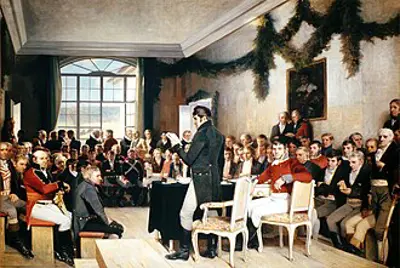
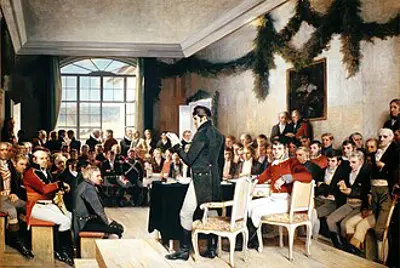
The Convention of Moss (Mossekonvensjonen) was a ceasefire agreement signed on 14 August 1814 between the King of Sweden and the Norwegian government. It followed the Swedish-Norwe…
A cease fire agreement, called the Convention of Moss, ended the Swedish–Norwegian War.
The War of 1812 was a conflict initiated by the United States against the United Kingdom and its allies fought mainly in North America and at sea during the wider Napoleonic Wars. …
War of 1812: British forces launch a costly and unsuccessful night attack against American defenders during the siege…
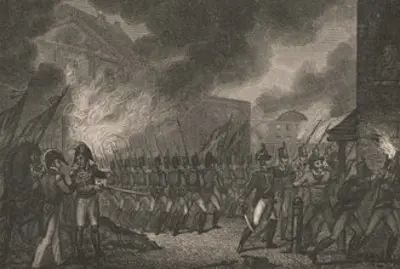
The Burning of Washington, also known as the Capture of Washington, was a successful British amphibious attack conducted by Rear Admiral George Cockburn during Admiral John Warren'…
British troops capture Washington, D.C. and set the Presidential Mansion, Capitol, Navy Yard and many other public…
Sir Robert Richard Torrens,, also known as Robert Richard Chute Torrens, was an Irish-born parliamentarian, writer, and land reformer. After a move to London in 1836, he became pro…
Robert Richard Torrens, Irish-Australian politician, 3rd Premier of South Australia (died 1884)
Didrik Ferdinand Didrichsen was a Danish botanist and physicist.
Ferdinand Didrichsen, Danish botanist and physicist (died 1887)
Samuel Colt was an American inventor, industrialist, and businessman who established Colt's Patent Fire-Arms Manufacturing Company and made the mass production of revolvers commerc…
Samuel Colt, American businessman, founded the Colt's Manufacturing Company (died 1862)
The War of 1812 was a conflict initiated by the United States against the United Kingdom and its allies fought mainly in North America and at sea during the wider Napoleonic Wars. …
War of 1812: On the second day of the Burning of Washington, British troops torch the Library of Congress, United…
The Convention of Moss (Mossekonvensjonen) was a ceasefire agreement signed on 14 August 1814 between the King of Sweden and the Norwegian government. It followed the Swedish-Norwe…
A cease fire agreement, called the Convention of Moss, ends the Swedish–Norwegian War.
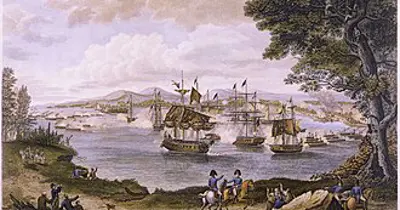
The Battle of Plattsburgh, also known as the Battle of Lake Champlain, ended the final British invasion of the northern states of the United States during the War of 1812. Two Brit…
War of 1812: The climax of the Battle of Plattsburgh, a major United States victory in the war.
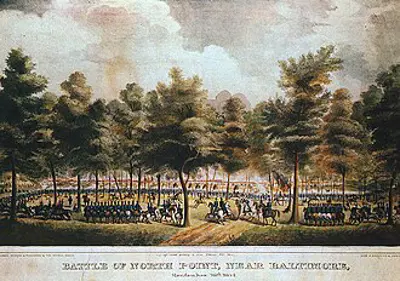
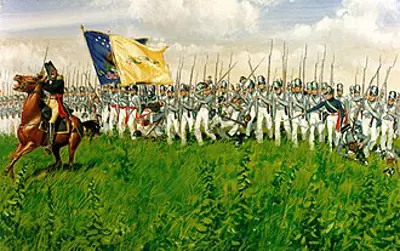
The Battle of North Point was fought on September 12, 1814, between General John Stricker's Maryland Militia and a British force led by Major-general Robert Ross. Although the Amer…
Battle of North Point: an American detachment halts the British land advance to Baltimore in the War of 1812.