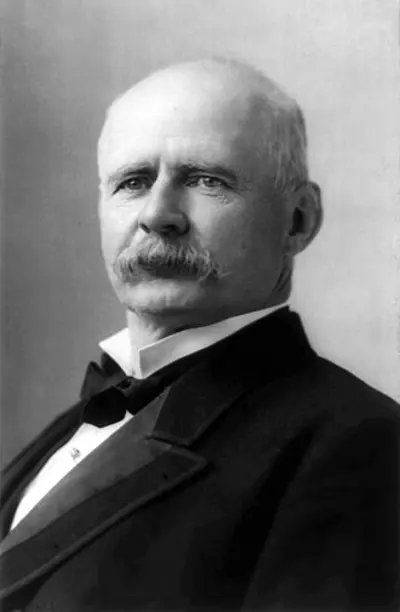
William Babington, Anglo-Irish physician and mineralogist (born 1756)
William Babington FRS FGS was an Anglo-Irish physician and mineralogist.
William Babington, Anglo-Irish physician and mineralogist (born 1756)
Explore 418 historical events from 1830β1839.
William Babington FRS FGS was an Anglo-Irish physician and mineralogist.
William Babington, Anglo-Irish physician and mineralogist (born 1756)
Sophia Campbell was an early Australian settler. She was the wife of politician Robert Campbell.
Sophia Campbell, English-Australian painter (born 1777)
Robert Hett Chapman was a Presbyterian minister and missionary and the second president of the University of North Carolina.
Robert Hett Chapman, American minister, missionary, and academic (born 1771)
Joseph-Nicolas-Blaise Forlenze, was an Italian ophthalmologist and surgeon, considered one of the most important ophthalmologists between the 18th and the 19th century. He was most…
Joseph Forlenze, Italian ophthalmologist and surgeon (born 1757)
Richard Trevithick was a British inventor and mining engineer. The son of a mining captain, and born in the mining heartland of Cornwall, Trevithick was immersed in mining and engi…
Richard Trevithick, English engineer and explorer (born 1771)
Oliver Wolcott Jr. was an American politician and judge. He was the second United States Secretary of the Treasury, a judge of the United States Circuit Court for the Second Circui…
Oliver Wolcott Jr
Gervasio Antonio de Posadas y Dávila was an Argentine lawyer and statesman who served as the first Supreme Director of the United Provinces of the Río de la Plata from 31 January 1…
Gervasio Antonio de Posadas, Argentinian lawyer and politician, 1st Supreme Director of the United Provinces of the…
Joseph Nicéphore Niépce was a French inventor and one of the pioneers of photography. Niépce developed heliography, a technique he used to create the world's oldest surviving produ…
Nicéphore Niépce, French inventor, created the first known photograph (born 1765)
Anselmo de la Cruz y Bahamonde was a Chilean political figure. He served several times as minister and participated actively in the war of independence in that country.
Anselmo de la Cruz, Chilean politician, Chilean Minister of Finance (born 1777)
William Wilberforce was a British politician, philanthropist, and a leader of the movement to abolish the Atlantic slave trade. A native of Kingston upon Hull, Yorkshire, he began …
William Wilberforce, English philanthropist and politician (born 1759)
The Siamese–Vietnamese wars were a series of armed conflicts between the Siamese Ayutthaya Kingdom and Rattanakosin Kingdom and the various dynasties of Vietnam mainly during the 1…
Siamese–Vietnamese wars: Lê Văn Khôi escaped from prison to begin a revolt against Emperor Minh Mạng, primarily to aveng
Yagan was an Aboriginal Australian warrior from the Noongar people. Yagan was pursued by the local authorities after he killed Erin Entwhistle, a servant of farmer Archibald Butl…
Yagan, a Noongar warrior wanted for leading attacks on British colonists in Western Australia, was killed, becoming a…
The London Conference of 1832 was an international conference convened to establish a stable government in Greece. Negotiations among the three Great Powers resulted in the establi…
Greece's independence is recognized by the Treaty of London
Juan Godoy was a Chilean farmer and miner who in 1832 discovered an outcrop (reventón) of silver 50 km (31 mi) south of Copiapó in Chañarcillo, sparking the Chilean silver rush.
Juan Godoy discovers the rich silver outcrops of Chañarcillo sparking the Chilean silver rush
The Battle of Stillman's Run, also known as the Battle of Sycamore Creek or the Battle of Old Man's Creek, occurred in Illinois on May 14, 1832. The battle was named for the panick…
The Battle of Stillman's Run, the first battle of the Black Hawk War, was fought
The Kingdom of Greece was the Greek state established in 1832 by the Treaty of Constantinople, which formally recognised Greece as an independent state and established it as a mona…
The First Kingdom of Greece is declared in the London Conference
Ibrahim Pasha was an Egyptian general and politician; he was the commander of both the Egyptian and Ottoman armies and the eldest son of Muhammad Ali, the Ottoman Wāli and unrecogn…
An Egyptian army under Ibrahim Pasha captures Acre from the Ottomans after a five-months siege
The June Rebellion, also called the Paris Uprising of 1832, was an anti-monarchist insurrection of Parisian republicans on 5 and 6 June 1832.
The June Rebellion breaks out in Paris in an attempt to overthrow the monarchy of Louis Philippe
The June Rebellion, also called the Paris Uprising of 1832, was an anti-monarchist insurrection of Parisian republicans on 5 and 6 June 1832.
The June Rebellion in Paris is put down by the National Guard
The Representation of the People Act 1832, also known as the Reform Act 1832, Great Reform Act or First Reform Act, was an act of the Parliament of the United Kingdom to reform the…
The Great Reform Act of England and Wales receives royal assent
José Echegaray y Eizaguirre was a Spanish civil engineer, mathematician, statesman, and one of the leading Spanish dramatists of the last quarter of the 19th century. He was awarde…
José Echegaray, Spanish poet and playwright, Nobel Prize laureate (died 1916)
Julius Sterling Morton was a Nebraska newspaper editor and politician who served as President Grover Cleveland's secretary of agriculture. He was a prominent Bourbon Democrat, taki…
Julius Sterling Morton, American journalist and politician, 3rd United States Secretary of Agriculture (died 1902)
The second cholera pandemic (1826–1837), also known as the Asiatic cholera pandemic, was a cholera pandemic that reached from India across Western Asia to Europe, Great Britain, an…
Asian cholera reaches Quebec, brought by Irish immigrants, and kills about 6,000 people in Lower Canada
John Neal was an American writer, critic, editor, lecturer, and activist. Considered both eccentric and influential, he delivered speeches and published essays, novels, poems, and …
John Neal delivers the first public lecture in the US to advocate the rights of women.