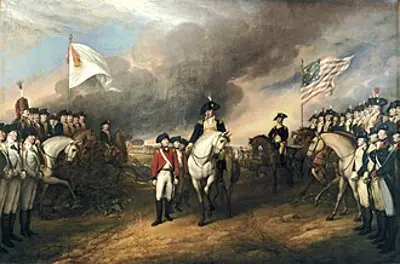
The American Revolutionary War, also known as the Revolutionary War or American War of Independence or simply the American Revolution, was the armed conflict that comprised the final eight years of the broader American Revolution, in which American Patriot forces organized as the Continental Army and, commanded by George Washington, defeated the British Army. The conflict was fought in North America, the Caribbean, and the Atlantic Ocean. The war's outcome seemed uncertain for most of the war, but Washington and the Continental Army's decisive victory in the Siege of Yorktown in 1781 led King George III and the Kingdom of Great Britain to negotiate an end to the war. In 1783, in the Treaty of Paris, the British Crown acknowledged the independence of the Thirteen Colonies, leading to the establishment of the United States as an independent and sovereign nation.
American Revolutionary War: British forces and their Iroquois allies attacked a fort and the village of Cherry Valley, New York, killing 14 soldiers and 30 civilians.
On November 11, in the year 1778, American Revolutionary War: British forces and their Iroquois allies attacked a fort and the village of Cherry Valley, New York, killing 14 soldiers and 30 civilians. This event is recorded as a Selected Events event in the history of November 11, one of 463 recorded events on this date across all of history.
Key Facts
- This event took place on November 11, 1778 (AD era).
- It is categorised as a Selected Events event in recorded history.
- Referenced in 4 Wikipedia articles.
- Wikipedia source last updated on 23 October 2026.
On This Date in History 463
This article draws on content from Wikipedia, available under CC BY-SA 4.0.
More on November 11
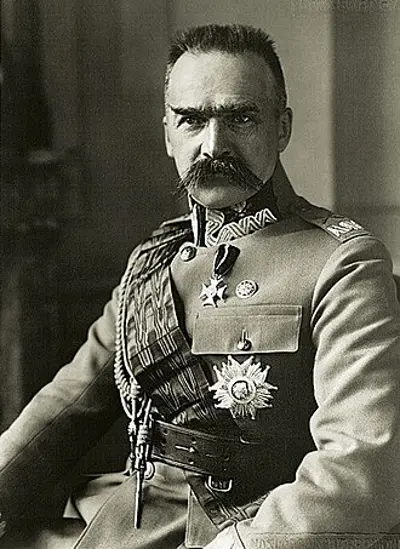
Józef Piłsudski (pictured), appointed the commander-in-chief of Polish forces by the Regency Council, was entrusted…
Józef Klemens Piłsudski was a Polish statesman who served as the Chief of State (1918–1922) and first Marshal of Poland. In the aftermath of World War I, he became an increasingly�
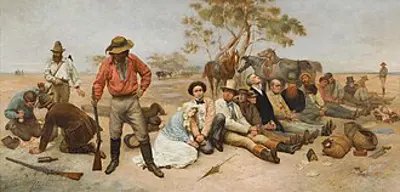
In spite of sympathizers holding rallies for his reprieve, Australian bushranger and outlaw Ned Kelly was hanged in…
Bushrangers were armed robbers and outlaws who resided in the Australian bush between the 1780s and the early 20th century. The original use of the term dates back to the early ye�
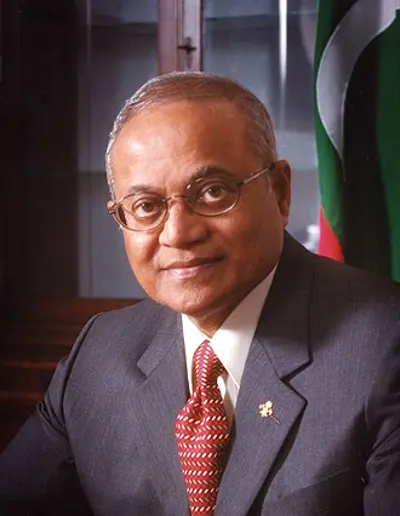
After 30 years in power, Maumoon Abdul Gayoom was succeeded by Mohamed Nasheed as president of the Maldives.
Maumoon Abdul Gayoom is a Maldivian politician, statesman and diplomat who served as the 3rd president of the Maldives from 1978 to 2008. He previously served as the Minister of T�
The House of Lords Act was given royal assent, removing most hereditary peers from the British House of Lords.
The House of Lords Act 1999 is an act of the Parliament of the United Kingdom which reformed the House of Lords, one of the chambers of Parliament. The act was given royal assent �
During a constitutional crisis, Governor-General Sir John Kerr (pictured) dismissed Prime Minister Gough Whitlam's…
The 1975 Australian constitutional crisis, also called the Dismissal, culminated with the dismissal of the prime minister, Gough Whitlam of the Australian Labor Party (ALP), by Si�
Rhodesia, led by Prime Minister Ian Smith (pictured), unilaterally declared independence from the United Kingdom.
Rhodesia, officially the Republic of Rhodesia from 1970 onwards, was an unrecognised state in Southern Africa that existed from 1965 to 1979. Rhodesia was the de facto successor t�
Comments 0
Sign in to join the discussion.