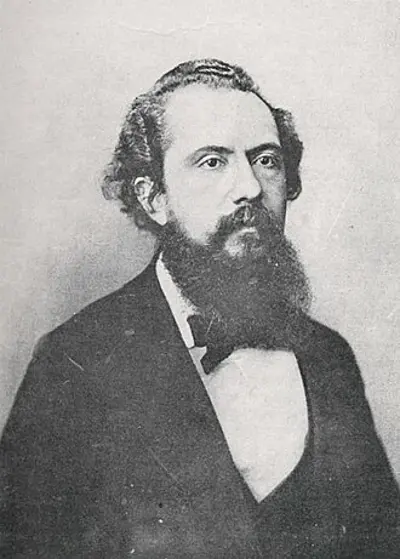
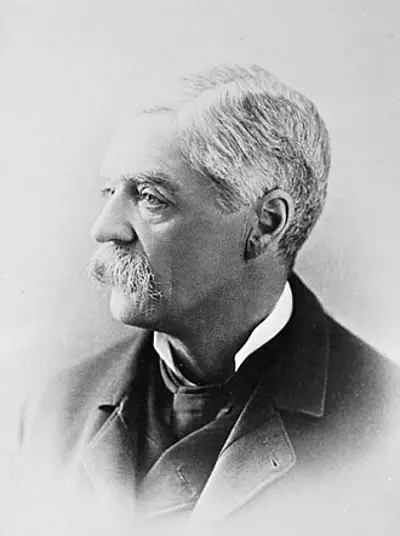
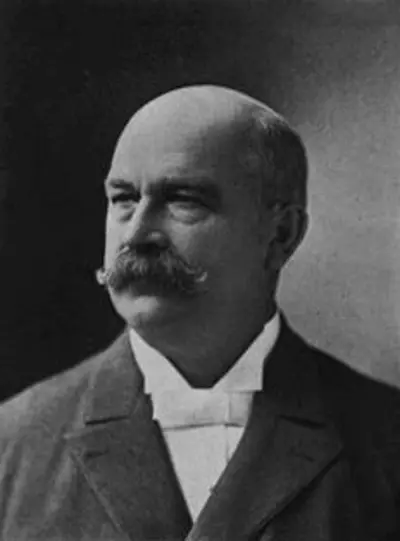
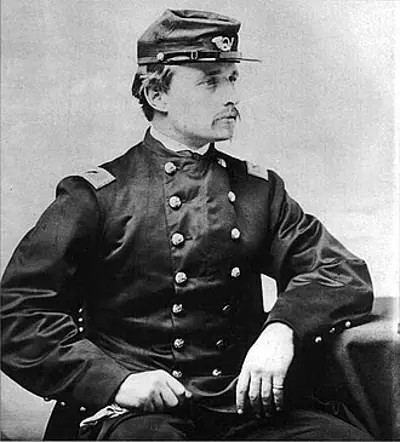
Zenas Ferry Moody, American surveyor and politician, 7th Governor of Oregon (died 1917)
Zenas Ferry Moody was the seventh governor of Oregon from 1882 to 1887.
Zenas Ferry Moody, American surveyor and politician, 7th Governor of Oregon (died 1917)
Explore 202 historical events from 1830β1839.
Zenas Ferry Moody was the seventh governor of Oregon from 1882 to 1887.
Zenas Ferry Moody, American surveyor and politician, 7th Governor of Oregon (died 1917)
Sir Edwin Arnold was an English poet and journalist. He is best known for his 1879 work, The Light of Asia.
Edwin Arnold, English poet and journalist (died 1904)
Nicolaus August Otto was a German engineer who successfully developed the compressed charge internal combustion engine which ran on petroleum gas and led to the modern internal com…
Nicolaus Otto, German engineer (died 1891)
Stephen Mosher Wood was an American politician. He Wood represented Chase County, Kansas in the Kansas House of Representatives in 1871 and 1875, and was a member of the Kansas Sen…
Stephen Mosher Wood, American lieutenant and politician (died 1920)
Alexandre Charles Lecocq was a French composer, known for his opérettes and opéras comiques. He became the most prominent successor to Jacques Offenbach in this sphere, and enjoyed…
Charles Lecocq, French pianist and composer (died 1918)
Lucy Petway Holcombe Pickens was a 19th-century American socialite of Tennessee and Texas, known during and after her lifetime as the "Queen of the Confederacy". She was also a Fir…
Lucy Pickens, American wife of Francis Wilkinson Pickens (died 1899)
Sir William Crookes was an English chemist and physicist who attended the Royal College of Chemistry, now part of Imperial College London, and worked on spectroscopy. He was a pion…
William Crookes, English chemist and physicist (died 1919)
Jeanne-Elisabeth Chaudet was a French painter and the wife of the sculptor Antoine Denis Chaudet, who had also been her teacher.
Jeanne-Elisabeth Chaudet, French painter (born 1761)
Zina Hitchcock was a New York politician. A descendant of the early American colonist Samuel Chapin, he was born on November 6, 1755, in Warren or New Milford, Connecticut. His fat…
Zina Hitchcock, New York politician (born 1755)
Jean Léopold Nicolas Frédéric, baron Cuvier, known as Georges Cuvier, was a French naturalist and zoologist, sometimes referred to as the "founding father of paleontology". Cuvier …
Georges Cuvier, French zoologist and academic (born 1769)
Sir James Mackintosh FRS FRSE was a Scottish jurist, Whig politician and Whig historian. His studies and sympathies embraced many interests. He was trained as a doctor and barriste…
James Mackintosh, Scottish historian, jurist, and politician (born 1765)
Évariste Galois was a French mathematician and political activist. While still in his teens, he was able to determine a necessary and sufficient condition for a polynomial to be so…
Évariste Galois, French mathematician and theorist (born 1811)
Divisional-General Jean Maximilien Lamarque was a French army officer and politician who served in the French Revolutionary and Napoleonic Wars. Lamarque served with distinction in…
Jean Maximilien Lamarque, French general and politician (born 1770)
Jeremy Bentham was an English philosopher, jurist, and social reformer regarded as the founder of modern utilitarianism.
Jeremy Bentham, English jurist and philosopher (born 1748)
Juan Godoy was a Chilean farmer and miner who in 1832 discovered an outcrop (reventón) of silver 50 km (31 mi) south of Copiapó in Chañarcillo, sparking the Chilean silver rush.
Prospector Juan Godoy discovered a silver outcrop in Chañarcillo, sparking the Chilean silver rush
The June Rebellion, also called the Paris Uprising of 1832, was an anti-monarchist insurrection of Parisian republicans on 5 and 6 June 1832.
The June Rebellion, an anti-monarchist uprising, broke out in Paris
The Representation of the People Act 1832, also known as the Reform Act 1832, Great Reform Act or First Reform Act, was an act of the Parliament of the United Kingdom to reform the…
The Reform Act, which is widely credited with launching modern democracy in the United Kingdom, received royal assent
The University of Alabama is a public research university in Tuscaloosa, Alabama, United States. Established in 1820 and opened to students in 1831, the University of Alabama is th…
The University of Alabama is founded in Tuscaloosa, Alabama
Rear-Admiral of the Red Sir James Clark Ross was a Royal Navy officer and explorer who explored both the North and South Poles. In the Arctic, he participated in two expeditions le…
James Clark Ross becomes the first European at the North Magnetic Pole
The Best Friend of Charleston was a steam-powered railroad locomotive widely considered the first locomotive to be built entirely within the United States for revenue service. It w…
The steam locomotive Best Friend of Charleston causes the first boiler explosion caused by a steam locomotive
Mary Louise Booth was an American editor, translator, and writer. She was the first editor-in-chief of the women's fashion magazine, Harper's Bazaar.
Mary Louise Booth, American writer, editor and translator (died 1889)
Emily Howard Stowe was a Canadian physician who was the first female physician to practise in Canada, the second licensed female physician in Canada and an activist for women's rig…
Emily Stowe, Canadian physician and activist (died 1903)
David Edward Hughes, was a Welsh-American inventor, practical experimenter, and professor of music known for his work on the printing telegraph and the microphone. He is generally …
David Edward Hughes, Welsh-American physicist, co-invented the microphone (died 1900)
Henry Vandyke Carter was an English anatomist, surgeon, and anatomical artist most notable for his illustrations of the book Gray's Anatomy.
Henry Vandyke Carter, English anatomist and surgeon (died 1897)